Sunday, January 1, 2023

7 Favorite Blogposts of 2022

Happy New Year! I surveyed folks on my email list about the blogposts from 2022 that they enjoyed most. Here are seven of their favorites.

1. Caga Tió- the Catalan Christmas Pooping Log!

Readers seemed to like my first blogpost about Caga Tió, a pooping Christmas log from Catalunya (pictured above). I can't believe this tradition hasn't caught on in the U.S. yet! If you started reading this blog recently, you may be wondering what this has to do with science, and the answer is absolutely nothing! I started writing about my experiences teaching in general and have more recently focused on science. 

2. Trashion Show: Weaving Art into Lessons on Human Impact and Sustainability

The Trashion Show blogpost describes an event in which my science students created outfits- some functional and some for show- out of used items. This project was part of a larger unit on sustainability. The entire school community was invited to attend the annual show, and it was always a favorite with students and families.  

3. Cell City: Cell Organelles Project

The Cell City project was inspired by a CrashCourse video in which a eukaryotic cell is compared to a tiny city. The project helps students make connections between city functions and the activity inside cells.

4. Why Do Leaves Change Color in the Fall?

Many readers enjoyed a piece I posted that was written by my daughter as a school assignment. While we were spending time in Maine, she researched why the leaves of deciduous trees change color in the fall. I was impressed with her work and thought others could learn from it, so we decided to publish it as a blogpost.

5. Personality Quiz with Plant Cell Parts

I created a plant cell personality quiz as a fun way to ease my students back into academics after spring break last year. I was surprised by how well the assignment worked in the classroom. Students enjoyed comparing their quiz results with friends as they reviewed plant cell parts and their functions.

6. Teaching Resources from the California Academy of Sciences

I have used many online resources from the California Academy of Sciences in the classroom, and recently my family visited the museum in San Francisco. In addition to the online resources, they offer field trips, and it was a great experience for our family!

7. Snow Science: Freezing and Melting Points the Same?!

This blogpost about snow science came from a conversation with my daughter about the best snow texture for making "snow women".  It's strange but true that the melting and freezing points are the same!

I hope that you enjoyed this blogpost and looking back at some favorites from 2022. If you are interested in joining my email list, please follow this link:


                                SUBSCRIBE TO EMAIL LIST


Thursday, December 15, 2022

Teaching Resources from the California Academy of Sciences


The online resources offered by the California Academy of Sciences have been valuable to me as a science teacher. Recently I took a trip to San Francisco and visited the museum with my family. We really enjoyed the exhibits, and it seemed like a wonderful place to bring students on a field trip. If you live in the Bay Area or are ever visiting, it's worth a trip!


The California Academy of Sciences is a sizable science museum that houses impressive exhibits on four floors. It's topped with a living roof covered in native plants that attract and feed local pollinators.


There were many exhibits in the museum that we enjoyed. Some of the highlights were the aquarium, the planetarium show, and a living rainforest exhibit. 

The aquarium presented marine ecosystems from around the world though we especially enjoyed viewing the large tank with kelp, sea anemones, and fish found on the California coast.


As we entered the rainforest exhibit, we immediately felt the increase in temperature and humidity. The exhibit is filled with tropical plants, and you can see butterflies fluttering close by.


I have a love of rocks and minerals and was impressed by their collection, which was beautiful to view. 


Tickets to the California Academy of Sciences can be a little pricey, but as of the writing of this blogpost, San Francisco school groups get free admission, and the ticket price is reduced for other school groups.

Before ever visiting the museum itself, I used multiple online teaching resources from the California Academy of Sciences with my middle school students. I always found the  resources, which include video simulations and short films, to be of a very high quality. 

One of my favorite resources is a short video simulation depicting a kelp forest food web that teaches students how sea otters, sea urchins, kelp, and other ocean life are connected to one another and to the sun. This video could be used to help teach standards related to ecology, particularly NGSS standard MS-LS2-3: Develop a model to describe the cycling of matter and flow of energy among living and nonliving parts of an ecosystem. Guiding questions to ask students are provided. Here is a link to the video:


Another video I like is a simulation of photosynthesis viewed from inside a leaf. This video is a good resource for teaching NGSS standard MS-LS1-6: Construct a scientific explanation based on evidence for the role of photosynthesis in the cycling of matter and flow of energy into and out of organisms. Here's a link to the video:


The California Academy of Sciences has multiple teacher resources that include lesson plans, videos, and short films available online at no cost. These resources along with information on field trips and professional development can be found here:


I hope that you enjoyed this blogpost and found it helpful. If you are interested in joining my email list, please follow this link:

                                SUBSCRIBE TO EMAIL LIST


Thursday, December 1, 2022

Students Give Back with Service Learning

Service learning experiences can get students out of the classroom and involved in parts of their community they don't typically interact with. Students gain new knowledge and a feeling of purpose as they learn how they can have a positive impact on their world.  

Involving students in service learning can be as simple as arranging times for older students to work with younger students as reading buddies or to do art projects together.


When I taught service learning as a class, my middle school students met with their K-2 reading buddies once a week for about 20 minutes per grade. This worked with our school schedule though longer blocks of times are nice, too. Sometimes the middle schoolers met up with their buddies during recess. The middle school students had a blast playing with the younger kids! The K-2 students always looked forward to seeing their older buddies.

Another nice way to help students serve while interacting with people of different ages is to visit assisted living facilities. We were lucky to have several of these homes within walking distance of the school. One year the class interviewed an elder couple and learned that they had met and married fairly recently. Students collected their life stories and used them to create a play that they performed. The couple had some great stories to tell, so this made for a very entertaining play! 

On other occasions, students spent time at the assisted living facility playing board games with residents. One day, a student decided to bring along his new virtual reality headset for the elders to try.

As you can imagine, both the elders and students benefitted from this time spent together.

During the COVID-19 pandemic, when visiting the assisted living facility was not possible, middle school students involved our entire K-8 school in creating cards for residents of assisted living facilities and nursing homes in our area. Students made cards for hundreds of elders in their community.


Also within the school's neighborhood is a community garden, and students helped out there by doing some weeding.

While working in the community garden, students had opportunities to try different herbs. Lemon sorrel was the most popular, and some ventured to try nasturtium flowers.


By trying different kinds of service learning, students had the opportunity to discover activities that they could enjoy while giving back to their community.

If you would like to read about how students gain voice and empowerment through their involvement in student council, follow this link to an earlier post on this topic:


If you are interested in an opportunity to help collect data on pollinator populations, follow this link:


I hope that you enjoyed this blogpost and found it helpful. If you are interested in joining my email list, please follow this link:


                                SUBSCRIBE TO EMAIL LIST


Tuesday, November 15, 2022

It's Tide Pool Season in California!


As we get closer to winter, the low tides become especially low, so this is an excellent time for viewing ocean life in tide pools. It's a time of year I always look forward to! 

Tide pooling season begins in the fall and continues through the winter and into early spring. It is at these times when you can catch a negative tide during the daytime. If you want to plan a trip, it is helpful to first consult a tide chart like this one for San Diego:

Tide Chart for San Diego

A ranger at Cabrillo National Monument said that any tide at or below 0.7 feet is good for viewing sea life, and the lower the tide, the better.

A trip to the tide pools is always a favorite among students. It feels great to get out to the ocean, and there are always so many things to explore and discover.


California Sea Hare

California Sea Hare Eggs

Tide pooling is a nice activity to do with your family, too!


If you plan to explore to explore tide pools with a school group and live in the San Diego area, Cabrillo National Monument offers some great ranger-lead programs for K-12 students. Their programs are free, and many are aligned with the Next Generation Science Standards (NGSS). 


With middle school students, I have participated in the Science Sampler and the Climate Kids programs, both for grades 5 - 12. The Science Sampler program engages students in practicing data collection on populations of organisms living in tide pools, modeling the way in which biologists collect this data at Cabrillo National Monument. The Climate Kids program addresses the affects of climate change, specifically ocean acidification, on sea life. 

Another benefit of a ranger-lead experience is having an expert help you spot hard-to-find creatures such as nudibranchs, sea hares, and on rare occasions, an octopus.

Spanish Shawl Nudibranch

If you are interested in learning more about the science programs offered at Cabrillo National Monument, follow this link:

Cabrillo National Monument Science Programs

Whether you explore tide pools independently or with a ranger, here are some things you might like to have with you:

* Closed-toe shoes with good traction (old sneakers)

* Pants that can be rolled up and warm layers on your upper body

* Sun protection (hat, sunscreen)

* Towel(s)

* Change of socks, shoes, and clothing (just in case you slip in the water)

* A Ziplock bag for your cell phone, if you bring one (not advised for students)

When wading in the tide pools, keep your eyes out for big waves, and avoid turning your back to them. Walk between the rocks rather than stepping on them. If you step on rocks to avoid walking in the water, you could easily slip on algae and really get yourself wet!

I hope that you enjoyed this blogpost and found it helpful. If you are interested in joining my email list, please follow this link:


                                SUBSCRIBE TO EMAIL LIST


Friday, November 4, 2022

Chemistry Project: Engineer a Heating Pad for Sea Turtle Eggs


Give your students the challenge of designing a prototype of a chemical heating pad that could be used to transport rescued sea turtle eggs. This chemistry project can be used to teach the Next Generation Science Standard (NGSS) MS-PS1-6: Undertake a design project to construct, test, and modify a device that either releases or absorbs thermal energy by chemical processes. The project also addresses the middle school engineering design standards.

The heating pad project was created by the American Chemical Society, which has multiple free lessons available online that are aligned with the Next Generation Science Standards (see link at the end of this post). 

With the modifications I used, the project took about five or six class periods to complete. Before beginning this project, students had completed labs investigating endothermic and exothermic reactions. 

Photo by David Troeger on Unsplash

To launch the project, I created a slideshow introducing students to factors that put sea turtles at risk. One factor is climate change. Whether sea turtle eggs develop into male or female babies is dependent on the temperature at which they are incubated. As temperatures continue to rise, the sea turtle population becomes increasingly more female. Another factor is illegal poaching. Sea turtle eggs are considered a delicacy, which makes them prized by poachers. To mitigate these threats, if sea turtle eggs could be transported safely, the eggs could be moved to a hatchery until baby turtles are ready to be released into the ocean.

Photo by David Reynolds on Unsplash

The last slides of the slideshow introduce students to the challenge of creating a chemical heating pad with these specifications:

The heating pad should...

  • Provide padding to the egg

  • Stay within the temperature range of 29 ℃  - 31 ℃ 

  • Remain within the temperature range for at least 5-10 minutes

Students are limited to making the heating pad out of these materials:

  • Calcium chloride and/or baking soda

  • Water

  • A resealable sandwich bag

I found that calcium chloride can be purchased relatively cheaply as fragrance free DampRid refill bags.

When students begin the project, they combine specified quantities of water, calcium chloride, and/or baking soda in order to observe changes in temperature. After making these initial observations, students are free to experiment with differing amounts of the substances to find a combination that best meets the specifications they are given. I required students to record the quantities of the substances they used and their observations for each trial and created simple tables to help them do this:


It's interesting to see how different students approach the design process. Some dive in and start experimenting with very different combinations of substances until they discover one that works well, while others are very methodical. I have observed that both strategies seem to work! I remind students to look at their data and use it to make thoughtful choices about the next iteration of their heating pad design.

Once I am able to gauge students' progress and can estimate when they will finish, I set a deadline for completion. On the final day of the project, students must demonstrate to me that their heating pad works. They measure and combine substances in their sandwich bag and show me how it stays within the desired temperature range for at least five minutes. I have done this demonstration in two different ways, either by having the entire class begin at the same time, or by asking lab partners to let me know when they are ready to begin.

After completing the demonstration of their heating pad, students reflect on why the heating pad might perform in an unexpected way for the demonstration. They also describe changes they would need to make for the heating pad to be commercially viable. For students who have problems demonstrating the performance of their heating pad on the final day of the project, I remind them that their grade is based on their recorded data and their ability to follow the engineering design process. They needed to use their data to make changes in the design of their heating pad as they were developing it.

If you would like to explore the American Chemical Society lesson plan on engineering a chemical heating pad, follow this link:


A previous blogpost explores a fun American Chemical Society lesson on polymers in which students create "gel worms":


Polymer Lab: Gel Worms


I hope that you enjoyed this blogpost and found it valuable. If you are interested in joining my email list, please follow this link:


                                SUBSCRIBE TO EMAIL LIST


Tuesday, October 18, 2022

Why Do Leaves Change Color in the Fall?


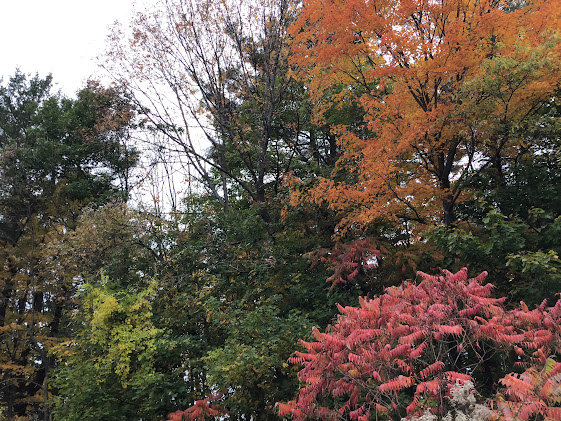
Why do leaves change color in the fall? This is the question I posed to my ten-year-old daughter when we took a short trip to Maine this month. I gave her the assignment of doing some research on the topic and writing a response. When I read what she had written, I thought that she had done very well with her explanation. I told her that we should share it with others, who might enjoy learning from what she had written. She suggested I post it on my blog, so here it is! The following piece and the photo of foliage above were done by her.

The leaves change color in the fall because the leaves start producing less chlorophyll. If you are wondering, chlorophyll is a chemical that makes leaves green. Chlorophyll is responsible for photosynthesis, when plants take in water and carbon dioxide and use sunlight to make sugar to feed themselves. In the fall, there is less sunlight, which means less photosynthesis for the plants and less need for chlorophyll. When this happens, the trees prepare to go dormant in the winter. Without chlorophyll, the green leaves start turning into red, orange, yellow, and brown leaves. As the chlorophyll breaks down, the carotenoids, orange-yellow and brown pigments, and anthocyanin, red and purple pigments, are revealed and/or created. (Most anthocyanin is created in the fall.) That is why sometimes the leaves are not solid colors, but a mix of colors because the carotenoids and the anthocyanin are slowly being revealed and/or created while the chlorophyll breaks down.

I hope that you enjoyed reading my daughter's work and perhaps learned something, too!

If you are interested in other blogposts related to science topics we explored while on vacation, here are a couple of links:

Snow Science: Freezing and Melting Points the Same?!


I hope that you found this blog post valuable. If you are interested in joining my email list, please follow this link:


                                SUBSCRIBE TO EMAIL LIST


Monday, October 10, 2022

Personality Quiz with Plant Cell Parts

                                                                                                                            Updated March 5, 2024

You can use a fun personality quiz to get your students better acquainted with the parts of a plant cell. What plant cell part best matches each of their personalities? Do your students like finding out information and passing it on like mRNA does? Maybe they are full of energy, like the mitochondria, or leaders, like the cell nucleus. When I created this activity for my sixth- and seventh-graders last year, I was pleasantly surprised by how much they enjoyed it!


As I was preparing my lessons for a return to school after a long Spring Break, I wanted to come up with an activity that would ease students back into their studies and provide a review of cell parts. We had already completed the Cell City project on animal cells, and I wanted to reinforce what they had learned about plant cells. A friend shared with me the idea of relating cell parts to different types of people. My daughter had been taking various personality quizzes and suggested I create one for my students related to cell organelles. This turned out to be a great idea!


The plant cell personality quiz I created has a very simple format: a Google slideshow with personality types on each slide, all referring to the last slide, which reveals which plant cell part the student would be. The last slide also includes a description of what the cell part does. Here is an example of one of the personality type slides:


After discovering which cell parts they would be, students report their results on a Google Form. They explain why their personality matches the cell part. Students also need to report the result of one peer and give their opinion of whether the cell part is a good match for their peer’s personality. Grading this assignment was fairly easy because in Google Forms, you can view the quiz results in a spreadsheet, allowing you to view all the students' results at the same time.


Before giving students the personality quiz, I told them that I had some guesses about what their personality quiz results would turn out to be. As they completed the quiz and I asked them about their results, I found that I had guessed correctly on many though some were a surprise! As students shared their results with me and one another, this activity turned out to be a way to not only review plant cell organelles but also to connect with one another.


I have posted this Plant Cell Personality Quiz for free on TPT. Here's the link:


Plant Cell Personality Quiz on TPT


If you are interested in a project related to cell parts, follow this link:


Cell City: Cell Organelles Project


I hope that you found this blog post valuable. If you are interested in joining my email list, please follow this link:


                                SUBSCRIBE TO EMAIL LIST